News
EFCC Chairman Hails Dauda Lawal’s Leadership, Says Zamfara Undergoing Remarkable Transformation


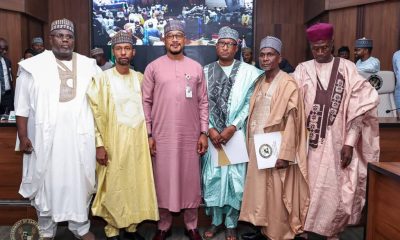
The Chairman of the Economic and Financial Crimes Commission (EFCC), Mr Olanipekun Olukoyede, has commended Zamfara State Governor, Dauda Lawal, for what he described as transformational leadership, citing visible improvements in infrastructure, education and governance across the state.
Olukoyede gave the commendation while delivering the keynote address at the 30th anniversary lecture of Zamfara State, held at the Grand Chamber of the Government House in Gusau.
The EFCC chairman disclosed that he conducted background checks on Governor Lawal and examined the state’s development trajectory before accepting the invitation to speak at the anniversary celebration.
According to him, his decision to attend was informed by the changes he observed in Zamfara over the past three years and his conviction that the governor’s administration deserved recognition and support.
“By virtue of the ethical demands of my office, I don’t attend political events; I don’t go to the Government House as a matter of principle. But when I received this invitation, something told me to accept and see what was going on there,” he said.
Olukoyede explained that after examining Zamfara’s history and the governor’s performance, he was sufficiently impressed to seek President Bola Tinubu’s approval to attend the event.
He said he had also drawn the President’s attention to the developments in Zamfara and the need to support the work being undertaken by Lawal’s administration.
Describing his visit to the state as his first, the EFCC chairman said the transformation became evident immediately after arriving in Gusau, particularly with the newly constructed airport, improved road networks and solar-powered streetlights.
He noted that Zamfara, despite its natural resources and enormous development potential, had historically struggled with the perception of underdevelopment and slow infrastructural growth since its creation in 1996.
However, he said the state’s contemporary outlook was changing, describing the physical transformation of Gusau as a reflection of the broader development taking place across Zamfara.
Olukoyede also highlighted improvements in the state’s performance in national examinations conducted by the National Examinations Council (NECO) and the West African Examinations Council (WAEC), alongside expanding public infrastructure.
He attributed the progress to deliberate reforms and sustained efforts by the present administration, noting that the developments aligned with the anniversary lecture’s theme, “Accountability and Responsibility in Transformational Government.”
The EFCC chairman further observed that inviting the head of an anti-corruption agency to address the people at the Government House demonstrated confidence and a willingness to embrace accountability.
According to him, it takes a serious-minded, committed democrat and transparent governor to have the courage to invite the EFCC chairman to speak directly to the people.
Earlier, Governor Lawal said the 30th anniversary theme, “Reflections, Achievements, and the Future,” was designed to encourage critical examination of Zamfara’s history, challenges and development prospects.
He explained that the anniversary was deliberately structured to go beyond ceremonial celebrations by creating an intellectual platform for discussions on public accountability, community participation in tackling insecurity, cultural preservation and the relationship between security and socio-economic development.
The governor said the discussions were central to his administration’s development priorities, particularly its Six-Point Rescue Agenda and the Zamfara State Development Plan 2025–2034.
According to him, the long-term development framework provides a roadmap for economic growth, infrastructure expansion, social welfare, human capital development, governance and environmental sustainability.
Lawal stressed that the ultimate objective was to translate government policies and commitments into measurable improvements in the living conditions of residents.
He expressed appreciation to the keynote speaker, academic contributors, discussants, organising committee and other participants for their contributions to the anniversary programme.
Other prominent speakers at the lecture included Professor Tijjani Muhammad Bande, Professor Sulaiman Kura, Professor Murtala Rufai and Professor Taofik Aminu, among others.
The anniversary lecture formed part of activities marking 30 years since the creation of Zamfara State in 1996.